

A great song is not a lucky accident of inspiration. It is a feat of engineering. It requires more than a melody and a mood. It requires an architect's eye for detail. You have likely felt the frustration of a lyric that sits heavy on the tongue. The sentiment is there. The rhythm is clunky. The rhyme feels predictable. You watch your original intent fade as you struggle to apply advanced songwriting techniques to a difficult verse. It is a common hurdle for the serious writer who views their work as a discipline.
This guide moves you beyond the basics. We will master the structural, rhythmic, and phonetic precision required for elite craft. You will learn to treat your lyrics with the reverence they deserve. We will examine the discipline of syllable counting and meter analysis. We will look at how to maintain rhythmic integrity across English, French, and Spanish. By the end, you will possess the tools to build songs that stand on a foundation of mathematical and emotional clarity. It is time to move from simple inspiration to true mastery.
Key Takeaways
- Align lyrical stress with musical downbeats. Syllable counting ensures melodic consistency and structural balance.
- Utilize slant rhymes and internal resonance. Phonetic texturing drives momentum within the line and avoids predictable patterns.
- Subvert standard song structures. Tension builds through intentional shifts in syllable density and extended narrative bridges.
- Master advanced songwriting techniques. Move beyond raw inspiration to achieve professional structural integrity.
- Treat editing as architecture. Relentless refinement preserves the weight of your artistic choices and protects your original intent.
Mastering Prosody: The Structural Alignment of Meter and Melody
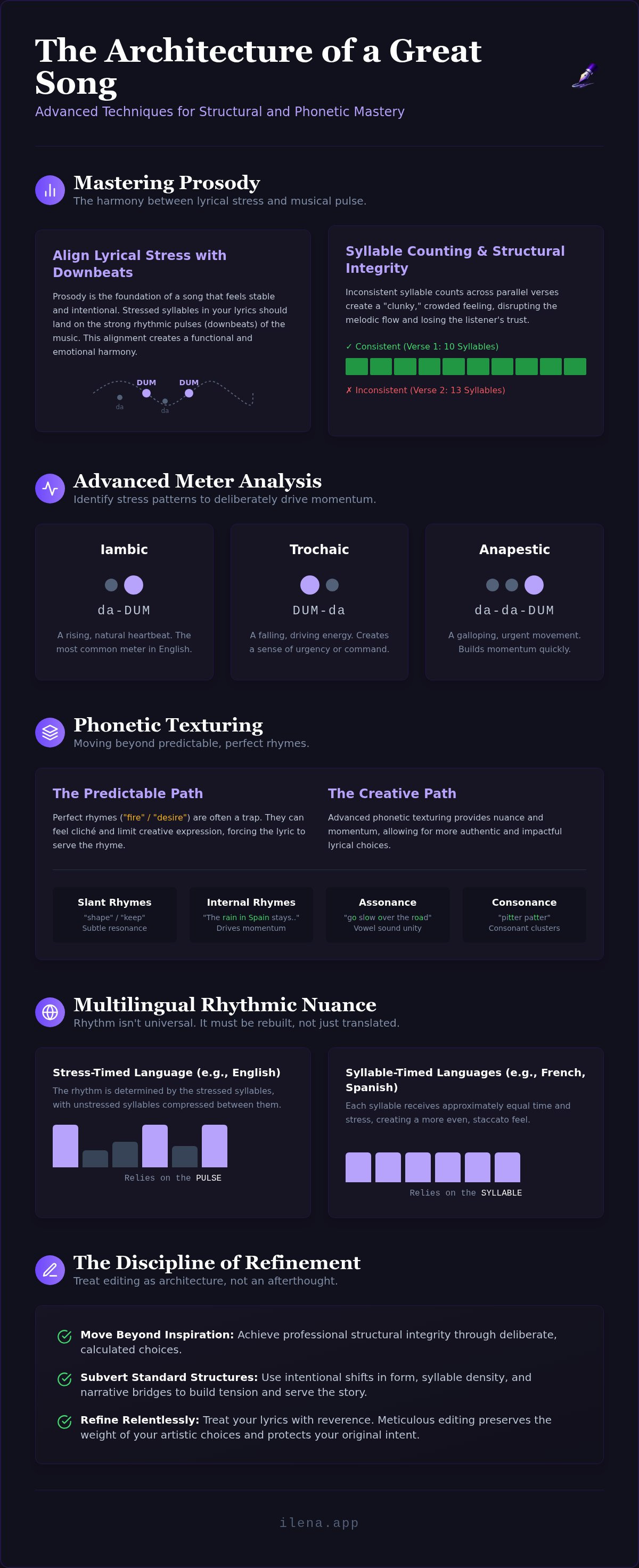
Songwriting prosody is the functional harmony between phonetic stress and rhythmic pulse. It is the marriage of lyrical stress and musical downbeats. Without this alignment, a song feels unstable. It feels unfinished. Applying advanced songwriting techniques requires a shift from raw feeling to precise calculation. You must treat the lyric as a rhythmic instrument. This is a core principle for Writing Effective Songs, where structural mechanics dictate emotional delivery. Precision here is not optional. It is the foundation of the craft.
Syllable Counting and Structural Integrity
Clunky lines usually suffer from inconsistent syllable counts across parallel verses. If your first verse has ten syllables and your second has thirteen, the melody will stumble. It'll feel crowded. You lose the listener's trust. Syllable analysis ensures your chorus hits with maximum impact. You must establish a rhythmic template before the first note is recorded. It's the architecture of the hit. It's the discipline of the elite writer who refuses to settle for "close enough."
Advanced Meter Analysis
Meter analysis identifies unintentional rhythm breaks. It uncovers where your stress patterns fight the beat. Most modern lyrics lean on specific patterns to drive momentum:
- Iambic: Da-DUM, da-DUM. A rising, natural heartbeat.
- Trochaic: DUM-da, DUM-da. A falling, driving energy.
- Anapestic: da-da-DUM, da-da-DUM. A galloping, urgent movement.
True mastery also involves rhythmic dissonance. You might intentionally break the meter for emotional effect. A sudden pause. A crowded line. These choices must be deliberate. They must serve the narrative. They shouldn't be an accident of poor editing. This level of control is what defines advanced songwriting techniques in a professional, focused workspace.
Phonetic Texturing: Beyond the Perfect Rhyme
The perfect rhyme is often a trap. It's predictable. It's expected. Modern songwriting demands a more nuanced approach to phonetic texture. Slant rhymes offer a subtle resonance that perfect rhymes cannot match. They provide the flexibility to say what you mean without compromising the sound. Internal rhyme acts as an engine. It builds momentum within the line itself. These aren't just aesthetic choices. They are structural decisions. A scholarly article on songwriting prosody highlights how these phonetic textures interact with the rhythmic pulse of the music. Sub-surface cohesion comes from assonance and consonance. The repetition of vowel sounds or consonant clusters creates a sense of unity. It grounds the listener. It makes the song feel intentional.
Multilingual Nuance in Rhyme and Rhythm
Writing across languages requires a deep understanding of linguistic architecture. English is a stress-timed language. We lean on the pulse. French and Spanish are syllable-timed. Every syllable carries equal weight. This fundamental difference dictates how you apply advanced songwriting techniques in a global context. You can't simply translate a lyric and expect the rhythm to hold. You must rebuild it. Leveraging a multilingual rhyme dictionary allows you to find phonetic resonances that a monolingual approach misses. It protects the writer's voice. It ensures the integrity of the craft remains intact, regardless of the tongue.
The Word Explorer as a Creative Compass
Discovery beats automation. A rhyme generator provides a list. A word explorer provides a path. You're looking for the exacting word. It must fit the meaning. It must also fit the phonetic texture of the line. Using synonyms and definitions allows you to find the word that sounds like what it means. This level of precision requires a focused workspace. If you're looking for a tool that respects your agency, you might find a companion in the multilingual word explorer. It doesn't write for you. It provides the environment for you to excel. Finding that one specific word is what separates a hobbyist from a disciplined practitioner of advanced songwriting techniques.
Structural Subversion: Breaking the Verse-Chorus Cycle
Standard structures are safe. They are predictable. They provide a comfortable map for the listener. But comfort is not always the goal of the elite writer. Structural subversion must serve the narrative arc, not just provide variety. It is an intentional choice to disrupt expectations to better tell a story. This level of control is a hallmark of advanced songwriting techniques. It requires a deep understanding of how form dictates feeling. It demands a willingness to let the story dictate the shape of the song.
The pre-chorus is your primary tool for tension. It acts as a pressure cooker. By analyzing and shifting syllable density, you prepare the listener for the release. Packing syllables tightly creates urgency. Stretching them creates a sense of suspension. The extended bridge serves a different purpose. It provides a narrative resolution. It is a destination where the themes of the song finally converge. Unlike a standard bridge, it doesn't just provide a break; it provides a conclusion. It is the final piece of the architectural puzzle.
Advanced Song Forms
Sometimes the most radical choice is to ditch the chorus entirely. AABA and AAA structures rely on the strength of the verse to carry the emotional weight. In these forms, the refrain acts as a punctuation mark rather than a summary. Through-composed songwriting moves even further afield. It never repeats. It moves in a continuous line. Cohesion here is found in phonetic motifs and rhythmic echoes rather than structural loops. It is a difficult discipline that rewards the focused mind. It is the ultimate test of structural integrity.
Managing Structural Versions
Radical structural shifts can be dangerous. You might lose the original spark in the pursuit of something new. Version management is the solution. It allows you to track the evolution of an idea without fear of deletion. You can experiment with advanced songwriting techniques and always find your way back. If you need a workspace that protects your creative history, explore version management for songwriters. It ensures that every structural experiment remains a part of your process rather than a lost draft. Integrity matters. Your work deserves a record of its growth.
The Discipline of Refinement: The Iterative Craft
Songwriting is ten percent inspiration. It is ninety percent relentless refinement. The initial spark is vital; the subsequent labor is where the art truly begins. You must treat the edit as a distinct creative mode. In the first draft, you are an artist driven by emotion. In the edit, you are an architect driven by precision. You move from the abstract to the structural. You weigh every syllable. You test the tension of every line. Professional lyricists never delete their failed attempts. They archive them. Version history is the map of your creative evolution. It is the record of your persistence in applying advanced songwriting techniques.
Protecting the Human Voice
Human authorship is the core of the discipline. AI-generated lyrics often lack the structural soul of human-crafted meter. They can mimic patterns, but they cannot feel the emotional weight of a rhythmic break. Technology should serve as an assistant, not a replacement. It should provide tools for syllable analysis and multilingual rhyme dictionaries. It should never use prompts to bypass the human struggle. A focused workspace acts as a digital sanctuary. It protects your agency from automated shortcuts. It respects the integrity of your effort. It values the weight of your artistic choices.
Final Polish and Meter Check
The final pass is a technical audit. It is the moment you ensure your work meets the highest standards of the craft. Before you finish, run through this checklist:
- Prosody: Does the lyrical stress align perfectly with the musical downbeat?
- Meter: Are there any unintentional rhythm breaks that disrupt the flow?
- Phonetic Resonance: Do the internal rhymes and assonance drive the momentum?
- Structural Integrity: Does the song form serve the narrative arc without being predictable?
This scrutiny is the final barrier between a hobby and a discipline. For those who seek this level of control, The Architect of Verse: Advanced Songwriting Software provides the environment you need to excel. It is time to master the architecture of your songs. Elevate your craft with Ilena’s advanced writing tools and move beyond raw inspiration into true mastery.
Building a Lasting Legacy
Mastery is a deliberate choice. It is the decision to move beyond the initial spark and embrace the rigorous technical demands of the craft. You have explored the mathematical alignment of meter and melody. You have seen how phonetic texturing and structural subversion provide depth and resonance. These advanced songwriting techniques transform a simple lyric into a lasting work of art. They require a focused workspace. They require a deep commitment to human authorship in a world increasingly filled with automated shortcuts.
Professional workflows demand tools that respect the writer's agency. You can refine your craft with Ilena’s advanced songwriting software. Our platform provides the multilingual syllable and meter analysis required for absolute precision across English, French, and Spanish. It offers robust version management to protect every step of your creative evolution. This is a human-centric sanctuary built specifically for the serious lyricist. It is a companion for your discipline.
Your work deserves this level of reverence. Every word carries weight. Every rhythm defines a moment. Every choice reflects your integrity as an artist. Continue to build your songs with the precision of an architect and the heart of a poet. The world is waiting for the integrity of your voice.
Frequently Asked Questions
What is the difference between songwriting meter and musical rhythm?
Meter is the inherent pattern of stressed and unstressed syllables within your lyrics. Rhythm is the actual placement of those syllables against the musical beat. Meter provides the linguistic blueprint; rhythm provides the temporal execution. When these two elements conflict, the song feels unstable. Mastery requires aligning the natural pulse of your words with the rhythmic pulse of your music.
How does syllable counting improve my song lyrics?
Syllable counting ensures structural balance and melodic consistency across your song. It prevents the common frustration of "clunky" lines where a second verse has too many syllables to fit the original melody. This is one of the most effective advanced songwriting techniques for achieving a professional, polished flow. It creates a predictable and satisfying experience for your listener.
Why should I use a rhyme explorer instead of an AI lyric generator?
A rhyme explorer acts as a creative compass that respects your individual agency. It offers phonetic possibilities without dictating your intent or "soul." AI generators often produce generic results that lack structural integrity and human depth. Using an explorer allows you to maintain the weight of your artistic choices. Discovery always beats automation in the pursuit of elite craft.
What are the most common mistakes in advanced song structure?
The most frequent error is using structural variety for its own sake rather than serving the narrative arc. Writers often add bridges or pre-choruses that don't build tension or provide necessary resolution. Another common mistake is failing to manage syllable density shifts during transitions. Every structural change must have a clear architectural purpose. It should never be an accident of indecision.
How do I manage different versions of my song lyrics effectively?
Effective management requires a dedicated system that tracks the evolution of your ideas without the risk of deletion. Professional lyricists archive every draft because "failed" attempts often contain the spark for a future breakthrough. Using specialized software for versioning allows you to experiment with advanced songwriting techniques with total confidence. Integrity requires a record of your creative growth.

