

Structure is not a cage for your creativity. It is the precision-engineered architecture that allows your emotion to resonate. Without a defined song lyric structure, even the most profound thoughts remain scattered. They fail to land. They lack the skeleton required to carry the weight of a melody. In an era where listener attention is the most guarded currency, a song must be built with intention from the first syllable.
You know the weight of a draft that refuses to cohere. Your lyrics feel disjointed. Your lines don't fit the meter. You find yourself trapped in a single verse, unable to bridge the gap to a resonant chorus. It's a common struggle for those who view songwriting as a discipline rather than a hobby. You'll master the structural blueprints used by elite lyricists to transform that chaos into professional clarity. We will replace your frustration with a refined process for iteration.
This guide provides a clear roadmap for building your songs from the ground up. We examine the specific purpose of every section and the logic behind their arrangement. You will understand how to navigate the 2026 landscape of front-loaded hooks and shorter song lengths without sacrificing your artistic integrity. It's time to build with purpose.
Key Takeaways
- Define your narrative modules to balance the comfort of familiarity with the impact of creative surprise.
- Adopt professional frameworks of song lyric structure, from the ubiquitous Verse-Chorus standard to the intimate AABA blueprint.
- Clarify the functional roles of each section, positioning the verse as your narrative engine and the chorus as your emotional core.
- Employ meter analysis and syllable counting to eliminate structural friction and ensure your lyrics land with rhythmic precision.
- Maintain a disciplined iteration process through version management to protect your creative breakthroughs from being lost.
The Architecture of Resonance: Defining Song Lyric Structure
A song is a living entity. It requires a skeleton to stand. It requires a map to travel. We define song lyric structure as the intentional arrangement of narrative and rhythmic modules. It is the deliberate placement of ideas. It is the calculated distribution of emotional weight. Many writers approach the page with a linear mindset. They follow the pen wherever it wanders. This is a draft. It is not yet a song. Professional songwriters operate as architects. They see the whole before they refine the parts. Linear writing is often a reaction. Architectural songwriting is a response. It is a design.
This architectural approach relies on prosody. Prosody is the marriage of lyrical structure and emotional intent. It is the alignment of form and feeling. If your lyric describes a frantic escape, the structure should mirror that urgency. If the theme is one of stillness, the framework must breathe. When these elements align, the song resonates. When they clash, the listener feels a subtle, jarring disconnect. Mastering song lyric structure allows the writer to command this resonance. Precision matters. Every section must serve the core.
The Psychology of Pattern Recognition
The human brain is a machine for finding meaning. It seeks patterns. It craves symmetry. When we listen to music, we enter into a silent contract with the creator. We expect certain common song structures to guide our journey. Repetition provides a sense of safety. It grounds the listener. Variation provides the spark of excitement. It keeps the mind engaged. Predictable structures become boring. Chaotic structures become exhausting. The master lyricist balances these forces. They use familiarity to build trust before introducing the surprise that creates impact. Chaos is not creativity. It is often a lack of discipline.
Transcending the Blueprint
Structure is not a restriction. It is a foundation for individual creative agency. Understanding the rules doesn't mean you are bound by them. It means you are empowered to break them with purpose. You move beyond the copy-paste approach to songwriting. You stop filling slots. You start building environments. Structural integrity in a lyric context is the state where every syllable and section serves the central emotional truth without collapse. It is the point where the draft becomes a finished work. It is the moment the architecture disappears, leaving only the song. True craft allows the listener to forget the blueprint and feel the heart.
The Universal Blueprints: Common Lyric Forms and Patterns
Every masterpiece begins with a blueprint. In songwriting, the blueprint is your form. Choosing a song lyric structure is a strategic choice. It is the first decision that determines how your story will land. You don't pick a form because it's easy. You pick it because it serves the emotional intent. Whether you seek the explosive energy of a radio hit or the quiet confession of a folk ballad, the framework is your foundation.
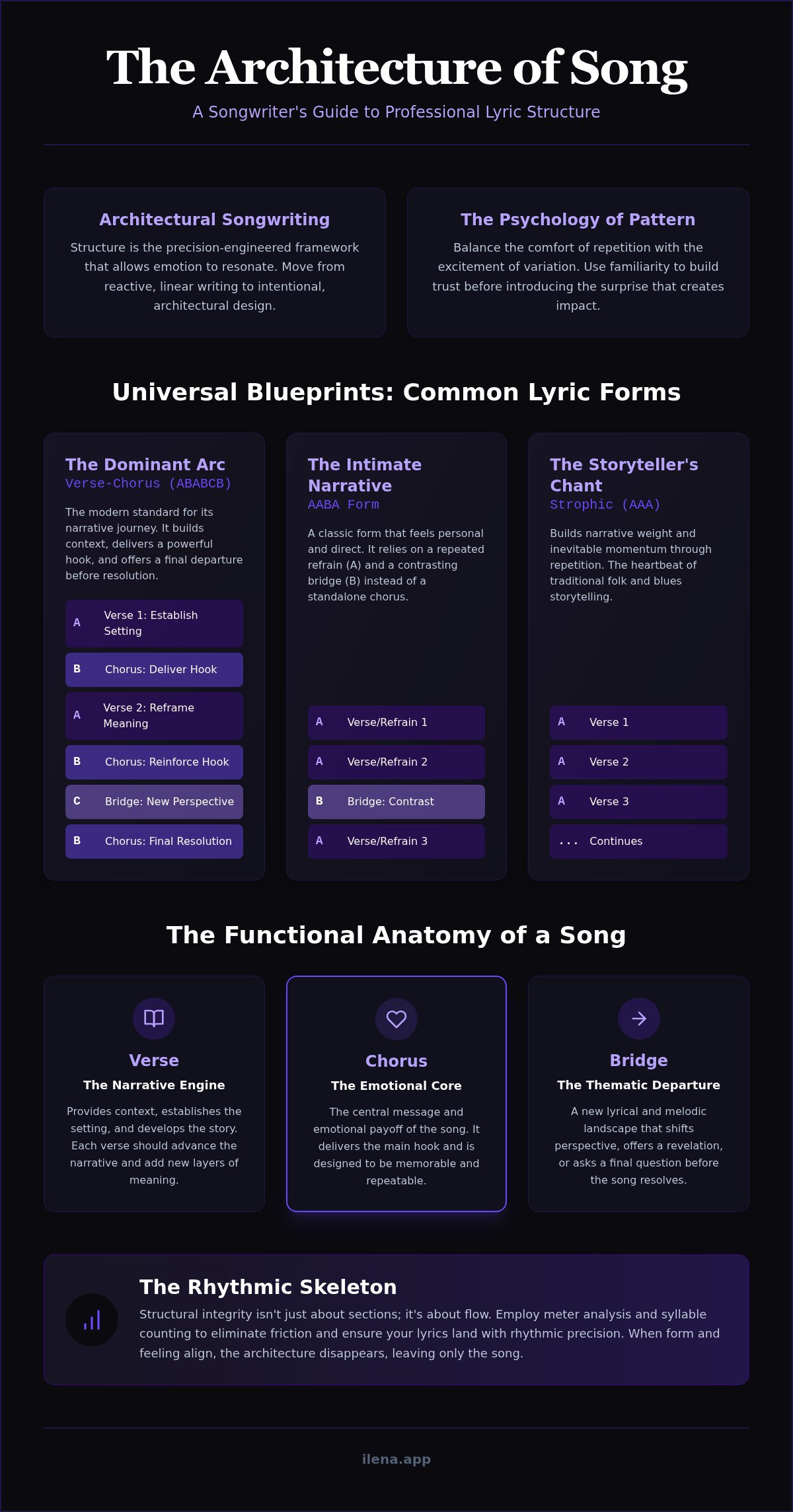
The Verse-Chorus Standard (ABABCB) dominates modern airwaves for a reason. It mirrors the way we communicate. We provide context in the verse. We deliver the emotional conclusion in the chorus. The Verse-Pre-Chorus-Chorus variation heightens this release. It creates a "lift" that makes the payoff feel earned. For more intimate narratives, the AABA form remains a gold standard. It lacks a standalone chorus, relying instead on a refrain to anchor the listener. It feels personal. It feels direct. Understanding how to use song structure allows you to select the right tool for the emotional task at hand.
The Dominant ABABCB Arc
The ABABCB flow is a narrative journey. Verse 1 establishes the setting. The Chorus delivers the hook. Verse 2 is where the craft truly begins. Elite lyricists use this section to subvert the first verse. They change the perspective. They reframe the meaning of the chorus that follows. The Bridge then provides a necessary departure. It is a new melodic and lyrical landscape. It offers the final piece of the puzzle before the resolution of the final chorus. This movement ensures the listener never stagnates. It keeps the heart engaged.
Alternative Structures for Specific Genres
Not every story fits a standard mold. Strophic form (AAA) uses relentless repetition to build narrative weight. It is the heartbeat of traditional folk and blues. It creates a sense of inevitable momentum. In rap and hip hop, a sectional approach often takes priority. Here, the focus shifts to rhythmic density and the "flow" of individual modules rather than a melodic hook. Experimental forms break these rules entirely. They prioritize atmosphere over predictability. When transitions feel clunky or forced, using a focused digital workspace for meter analysis can help you bridge the gap between sections with precision. Your structure should always follow your function. Build the house that your story needs to live in.
The Functional Anatomy: Understanding Verses, Choruses, and Bridges
A song is a functional system. It is more than a sequence of lines. Each section has a specific duty. If one module fails, the entire song lyric structure collapses. You must treat these components with the reverence they deserve. Understanding the building blocks of a song is the difference between a chaotic draft and a professional work. Every section must earn its place on the page.
The verse is your narrative engine. It establishes the setting. It introduces the characters. It defines the conflict. Without a strong verse, the chorus has no foundation. It feels unearned. The pre-chorus acts as a transitional ramp. It builds tension. It prepares the ear for the emotional release. Then comes the chorus. This is the emotional core. It is the universal truth. Finally, the bridge offers the pivot. It provides a new perspective. It breaks the rhythmic pattern to prevent listener fatigue. It is the departure that makes the return home feel powerful.
Verses as Narrative Progressions
Verses must move. They cannot stagnate. Each verse should advance the plot or deepen the character's internal world. Use sensory details here. Describe the scent of the room. Mention the weight of the key. These concrete images provide a necessary contrast to the abstract emotions of the chorus. Rhythmic stability is vital. Maintaining consistent syllable counts across your verses ensures the melody remains grounded. It prevents the clunky transitions that distract the listener from your message. Precision in the verse allows the chorus to soar.
The Chorus as the Universal Truth
The chorus is your destination. It is the "Hook." It must be linguistically and rhythmically memorable. A great chorus feels like a logical conclusion to the preceding verses. It summarizes the central theme in a way that feels inevitable. It is the part of the song lyric structure that the listener carries with them. To make the final chorus feel more impactful than the first, consider the weight of the journey. The words remain the same, but their meaning has evolved. Let the final repetition carry the full emotional burden of the story. It should land with finality. It should land with truth.
The Rhythmic Skeleton: Meter, Syllables, and Structural Precision
A lyric is a rhythmic event. It is not merely a collection of words. It is a sequence of stresses. It is a series of durations. Without a rhythmic skeleton, your song lyric structure remains fragile. It lacks the internal strength to carry a melody. Professional songwriters don't guess. They measure. They count. Syllable counting ensures that every line fits the musical bars with mathematical certainty. It removes the friction of clunky transitions. It creates a seamless experience for the listener.
Meter is your tool for structural cohesion. Whether you employ the rising pulse of the iambic or the falling weight of the trochaic, meter defines the song's heartbeat. It is the unseen foundation. Syllables carry different weights. Some are sharp. Some are elongated. These choices influence the pulse of the track. They determine where the listener breathes. They dictate where the emphasis lands. Precision here is the mark of a disciplined writer.
Meter as the Unseen Foundation
Many writers rely on flow. They write what feels good. This is often a mistake. Feel is subjective and prone to error. Meter analysis is objective. It identifies exactly where a line is fighting the rhythm. It reveals the hidden obstacles in your draft. Syllabic symmetry is the deliberate alignment of line lengths and stress patterns across corresponding sections to ensure rhythmic predictability and melodic ease. When symmetry is ignored, the song lyric structure feels unstable. The ear detects the flaw even if the mind cannot name it.
Multilingual Lyricism and Syllabic Stress
Structural expectations shift across languages. English is a stress-timed language. It relies on the contrast between heavy and light syllables. Spanish is syllable-timed. It prioritizes the steady march of equal beats and the resonance of assonance. French offers a different weight entirely. It is fluid. It is less reliant on harsh accents. Writing across these boundaries requires a deep respect for cadence. Maintaining craft in a second or third language demands tools that can parse these nuances. Use Ilena's syllable counter and meter analysis to achieve multilingual precision. Do not leave your rhythm to chance. Treat your syllables as the valuable assets they are.
The Craft of Refinement: Organizing and Iterating Your Lyric Structure
Songwriting is rarely a straight line. It is a series of departures and returns. The first song lyric structure you envision is often a starting point rather than a final destination. Professionalism lies in the willingness to iterate. It is the discipline to refine a verse until it carries the necessary weight. You must transition from the initial brain dump to a structured final draft with surgical precision. This transition requires a workspace that respects the messy reality of creation. It requires an architect's desk where ideas can be examined, dismantled, and rebuilt without losing their original essence. Integrity in craft demands that you treat your drafts as living documents.
The Iterative Draft: Refinement over Replacement
Never delete a structural idea. A bridge that feels out of place today may be the perfect pivot for a different project tomorrow. Version management is essential to the serious writer. It allows you to track the evolution of your work without losing the original spark. You should be able to compare different chorus variations side by side. You should be able to test a new bridge without destroying the previous one. A focused digital sanctuary allows you to manage the messy middle of the creative process. It protects your creative history. It preserves your agency. It allows you to see the path you've traveled so you can choose the best path forward. Refinement is not about fixing mistakes. It is about uncovering the strongest possible version of your story.
Choosing the Right Workspace for Lyricists
General purpose word processors fail the modern songwriter. They are designed for static documents. They are not designed for the living rhythm of a lyric. They lack the tools required for deep, structural craft. A dedicated lyricist workspace provides integrated utilities that honor the discipline of writing. It offers syllable counters to ensure symmetry. It provides meter analysis to prevent clunky transitions between your narrative modules. It includes rhyme explorers and multilingual tools to unlock new linguistic paths in English, French, or Spanish. These tools don't write the song for you. They provide the environment for you to excel. They act as a quiet, focused companion in your creative process.
Before you consider a song finished, perform a final structural integrity check. This ensures your song lyric structure is sound and ready for melody:
- Does every module serve the central emotional truth of the piece?
- Are the syllable counts consistent across corresponding verses for rhythmic stability?
- Does the bridge provide a genuine narrative or rhythmic departure from the rest of the song?
- Is the transition to the chorus earned, and does the hook land with finality?
- Have you preserved your previous versions in case the original spark needs to be revisited?
Refine your craft with Ilena's specialized lyricist workspace. Protect your work. Honor your process. Build something that resonates.
Building Your Legacy Verse by Verse
Your craft is a discipline. It requires more than inspiration. It requires a commitment to the structural integrity of your message. You have explored the blueprints that define modern resonance. You have seen how meter and syllable count provide the rhythmic skeleton for your narrative. Structure is the bridge between a fleeting thought and a lasting legacy. It is the framework that allows your truth to be heard without distraction.
Mastering your song lyric structure is a lifelong pursuit of precision. It is the refusal to accept clunky transitions. It is the choice to iterate until every line lands with weight. Your work deserves a workspace that honors this level of dedication. It deserves a sanctuary where human effort is the primary focus.
Refine your song's structure with Ilena's craft-centric tools. Experience advanced syllable and meter analysis for perfect rhythm. Utilize a multilingual rhyme dictionary for English, French, and Spanish. Protect your creative process with seamless version management for every draft.
The page is ready. The architecture is yours to build. Step into your focused workspace and begin your next work with confidence.
Frequently Asked Questions
What is the most common song structure used in pop music?
The most common song lyric structure in modern pop is the Verse-Chorus-Bridge (ABABCB) framework. It establishes a clear narrative, delivers a memorable emotional hook, and provides a necessary departure before the final resolution. This form dominates because it balances listener familiarity with constant narrative movement. It keeps the audience grounded while ensuring the story reaches a logical conclusion. It is a proven blueprint for resonance.
How many lines should be in a standard verse?
A standard verse typically consists of four, eight, or sixteen lines. Eight lines are often the professional choice for providing enough narrative detail without delaying the emotional payoff of the chorus too long. The line count must remain consistent across all verses to maintain rhythmic stability. Symmetry here is the hallmark of a disciplined writer. It ensures your melody remains focused and your listener remains engaged.
What is the difference between a bridge and a pre-chorus?
A pre-chorus is a transitional ramp designed to build tension toward the chorus. It is usually short and leads the ear forward with rising intensity. A bridge is a complete pivot point that offers a new perspective or a rhythmic shift. It provides a departure from the established patterns of the verse and chorus. One builds anticipation; the other provides relief through variation. Both serve distinct structural roles.
Can a song have a structure without a chorus?
A song can certainly exist without a chorus. Strophic forms (AAA) and AABA structures rely on refrains or narrative weight rather than a standalone hook. These forms are often used in folk, blues, and intimate storytelling where the narrative progression is the primary focus. The absence of a chorus creates a sense of directness and honesty. It forces the listener to engage deeply with the evolving story.
How do I know if my song structure is too repetitive?
Your structure is too repetitive if the narrative stagnates or the rhythm becomes entirely predictable. If the second chorus feels exactly like the first without any added emotional weight, the song has failed to move. Use meter analysis to identify where the pulse has become a drone. Variation is the antidote to listener fatigue. Every repetition must feel earned. Every repetition must feel like progress.
Does every song need a bridge?
Not every song requires a bridge. If the transition between your verses and choruses provides enough emotional satisfaction, a bridge might be unnecessary clutter. You should only include a bridge if the story requires a new perspective or the listener needs a break from the established rhythm. Every section must earn its place on the page. Integrity in craft means knowing when a song is already complete.
How does syllable counting help with song structure?
Syllable counting ensures that your lyrics fit the musical bars with mathematical precision. It prevents lines from being too crowded or too sparse for the intended melody. This technical discipline allows the song lyric structure to feel effortless rather than forced. It is the foundation of professional rhythmic cohesion. When you count your syllables, you remove the hidden obstacles that cause clunky transitions and listener distraction.
Is it okay to change the structure of a song after it's written?
It is vital to change the structure of a song if it improves the emotional impact. Songwriting is an iterative process. You shouldn't feel bound by your first draft. Professional writers use version management to track structural shifts. They compare different arrangements until the architecture feels sound. Integrity lies in the refinement. Refinement is the process of uncovering the strongest possible version of your truth.
